

The 2026 Korean Pavilion at La Biennale di Venezia - Liberation Space: Fortress/Nest
4 minute read
August 27, 2026
The International Art Exhibition of La Biennale di Venezia is one of the world’s most prominent art events, presenting acclaimed artists and artworks from around the globe.
Hyundai Motor Company has supported the Korean Pavilion since 2015 and will continue its official partnership with Arts Council Korea (ARKO), the Korean Pavilion’s commissioner, as a lead supporter through 2034. Through this extended partnership, Hyundai Motor reaffirms its long-term commitment to advancing contemporary art within the global cultural discourse.
Introducing the 61st International Art Exhibition of La Biennale di Venezia
The 61st International Art Exhibition of La Biennale di Venezia unfolds under the theme “In Minor Keys,” using the musical concept of the minor key as a metaphor to explore contemporary emotions, sensory perception, and the ways we relate to one another. Alongside the national pavilions in the Arsenale and the Giardini, including the Korean Pavilion, the exhibition brings together 110 participating artists and a diverse program of collateral events presented across Venice, inviting visitors on a seven-month journey.
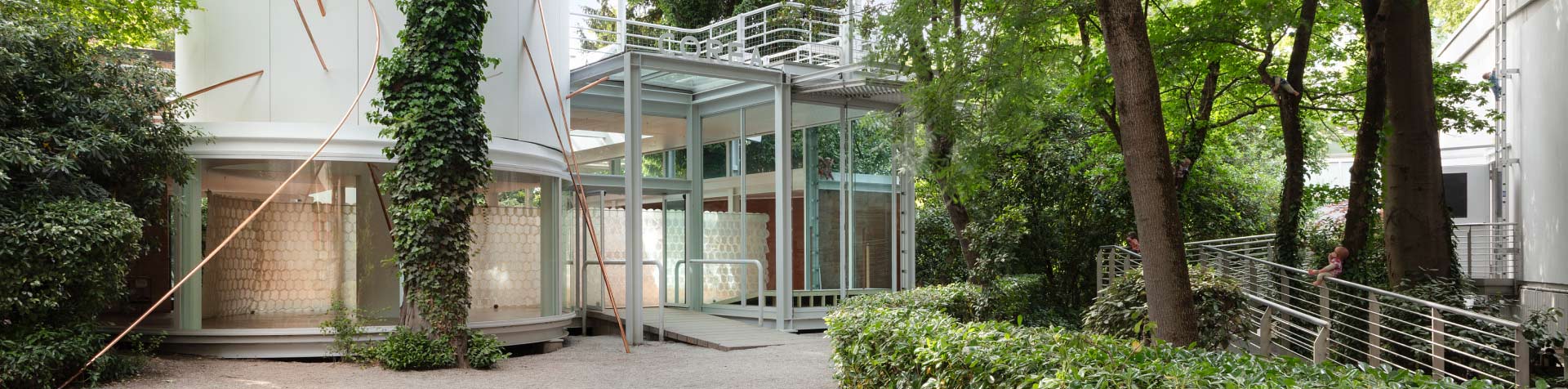
© Installation view of Liberation Space: Fortress/Nest, Korean Pavilion, 2026. Image provided by Hyundai Motor Company. Photo: Andrea Rossetti / Héctor Chico.
Liberation Space: Fortress/Nest
The Korean Pavilion presents Liberation Space: Fortress/Nest, curated by Binna Choi, with works by artists Goen Choi and Hyeree Ro.
Conceived as a living monument, the exhibition reimagines the notion of “Liberation Space,” rooted in Korea's post-liberation period (1945–1948), through the lens of contemporary geopolitical and social conditions.
Through sculptural interventions that engage directly with the Pavilion’s architecture, the project explores liberation not as a fixed historical moment, but as an ongoing process of movement, resilience, protection, and renewal.
© Installation view of Liberation Space: Fortress/Nest, Korean Pavilion, 2026. Image provided by Hyundai Motor Company. Photo: Andrea Rossetti / Héctor Chico.
© Hyundai Motor Company
Transforming the Korean Pavilion into a Living Monument to "Liberation Space"
Goen Choi | Meridian
Goen Choi’s Meridian builds on her decade-long sculptural practice using industrial materials commonly found in domestic and urban infrastructures. For the Korean Pavilion, copper pipes traverse interior and exterior architectures, evoking linear forms such as needles, spears, branches, or beams of light. As these forms weave through and pierce the Pavilion, they simultaneously suggest processes of circulation, connection, and healing.
© Installation view of Liberation Space: Fortress/Nest, Korean Pavilion, 2026. Image provided by Hyundai Motor Company. Photo: Andrea Rossetti / Héctor Chico.
By crafting precisely positioned forms from industrial materials, Choi evokes the idea of a “fortress” — not as a closed or static structure, but as one that remains open to revelation, connection, and dynamic movement arising from within the Pavilion itself. By reopening architectural spaces long closed, Choi transforms the Pavilion into a living environment shaped by continual reorientation. In doing so, the installation frames the Korean Pavilion not only as a site of protection, but as an active body capable of change.
© Goen Choi, Meridian, 2026. Installation view of presentation in Liberation Space: Fortress/Nest. Photo: Donghwan Kam.
Hyeree Ro | Bearing
Hyeree Ro’s Bearing presents an expansion of her scope of practice, departing from her longstanding (anti-)narrative approach and explorations of family relations shaped by sociopolitical and economic conditions. For this exhibition, Ro positions the work within intimate and collective registers by including themes of new life, care, community, and nationhood.
© Installation view of Liberation Space: Fortress/Nest, Korean Pavilion, 2026. Image provided by Hyundai Motor Company. Photo: Andrea Rossetti / Héctor Chico.
Bearing considers the “womb” as a sanctuary or temple for new life, where death is not an endpoint but a condition that enables life and movement. Composed of approximately 4,000 organza elements coated in wax and layered like fish scales or lotus leaves, the installation forms a “pavilion within the pavilion”. Resisting enclosure, it guides visitors through a carefully choreographed passage punctuated by eight stations, each prompting an essential act of life, including mourning, remembering, observing, living, waiting, planning, sharing, and repairing. Every day, a “Bearer” walks through these stations twice, practicing each different mode of engaging with “Liberation Space.”
Fostering the network of “Liberation Space,” the Pavilion also brings together Fellows from various fields, whose stories unfold through The Reader, further expanding the exhibition’s experiential scope. The first volume provides audiences with deeper contextual knowledge, with a second volume to follow.
© Installation view of Liberation Space: Fortress/Nest, Korean Pavilion, 2026. Image provided by Hyundai Motor Company. Photo: Andrea Rossetti / Héctor Chico.
Transnational Dialogue Between the Korean and Japan Pavilions
For the first time in the history of La Biennale di Venezia, an official collaboration has been established between the Korean Pavilion and the Japan Pavilion. Symbolizing this transnational dialogue, Goen Choi's installation extends across the wooded boundary between the two pavilions. Her copper pipes traverse and connect the sites like stitches, subtly weaving together separate architectural and geopolitical spaces. Echoing this gesture of connection, baby dolls—a central motif of the Japan Pavilion exhibition—are positioned on the roof of the Korean Pavilion, creating unexpected points of encounter between the two presentations.
Through these spatial and symbolic gestures, the collaboration emphasizes dialogue, exchange, and artistic cooperation, acknowledging shared and contested histories while foregrounding possibilities for mutual engagement through cross-participation and joint programming.
© Goen Choi, Corea Pavilion – Bush – Giappone Pavilion, 2026 (special artwork co-commissioned by the artists and curators of the Korean Pavilion and Japan Pavilion). Installation view of presentation in Liberation Space: Fortress/Nest. Photo: Donghwan Kam.
For the past decade, we have been honored to support artists in sharing their creative visions with the world through the Korean Pavilion at La Biennale di Venezia. By continuing our partnership for another ten years, Hyundai Motor reaffirms its deep commitment to supporting the Korean Pavilion as a sustainable ecosystem for nurturing experimental artistic practices and critical discourses. We look forward to the compelling conversations the Korean Pavilion will inspire for years to come. – DooEun Choi, Art Director, Hyundai Motor Company
The 61st International Art Exhibition – La Biennale di Venezia will be held from May 9 to November 22, 2026, in Venice, Italy, with main venues including the Giardini and the Arsenale.
Visitor information and ticket details for La Biennale di Venezia are available at: https://www.labiennale.org/en/art/2026/information
More information can be found at: www.korean-pavilion.or.kr and www.venicebiennale.kr/en